
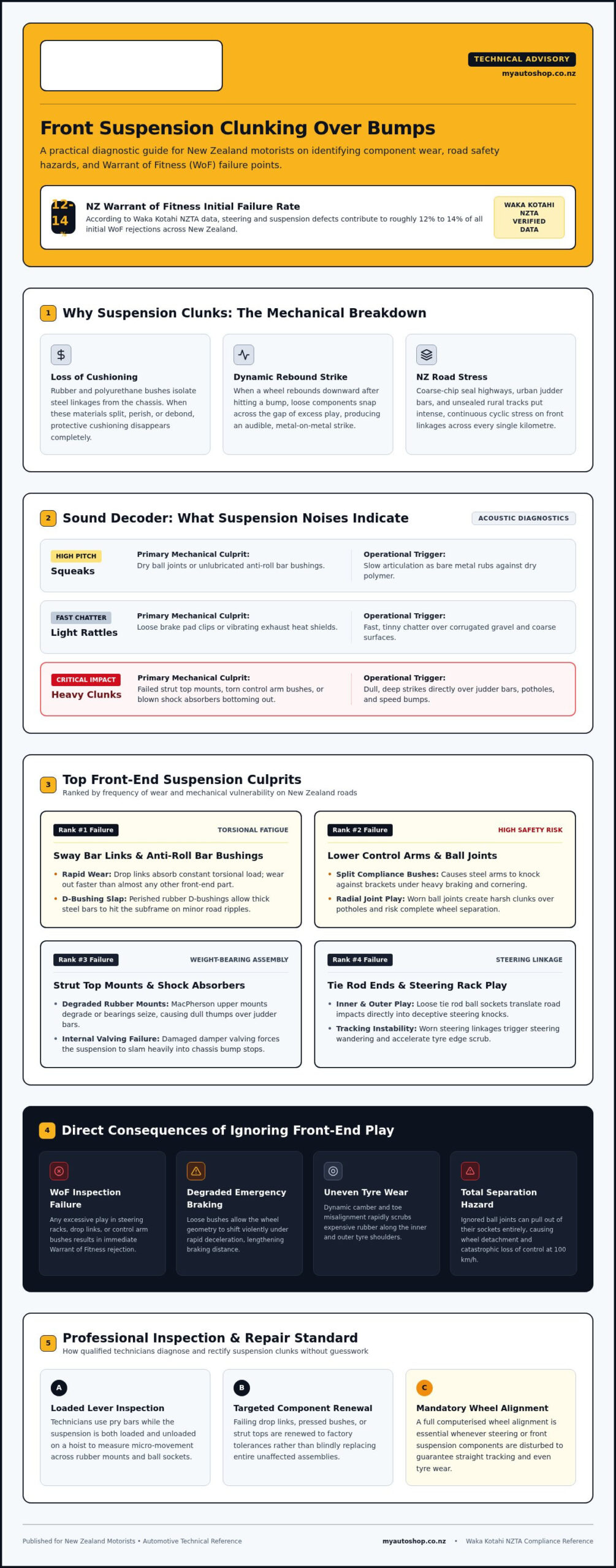
According to Waka Kotahi NZTA data, steering and suspension defects contribute to roughly 12% to 14% of all initial Warrant of Fitness failures in New Zealand. That jarring clunking noise from front suspension over bumps isn’t just an annoying quirk of coarse-chip seal; it’s a direct mechanical warning that components designed to protect your chassis are making loose, metal-on-metal contact.
Hearing a heavy thud over every judder bar or pothole is genuinely unsettling. It’s completely natural to worry about losing steering control at 100 km/h, not to mention the anxiety of facing an unexpected workshop bill right before your WoF inspection is due.
You don’t have to stay in the dark about what is happening beneath your car. This guide walks you through the most common component failures on local roads, shows you how to determine whether your vehicle is still safe to drive, and explains how professional Kiwi technicians accurately diagnose and resolve front-end clunks.
Key Takeaways
- Pinpoint the most common mechanical culprits behind a clunking noise from front suspension over bumps, including sway bar links, worn bushes, and top strut mounts.
- Understand the immediate driving risks of ignoring front-end play, from degraded emergency braking and uneven tyre wear to an outright Warrant of Fitness (WoF) rejection.
- See how professional technicians systematically inspect suspension linkages to isolate the exact failing part without costly guesswork.
- Learn what happens during a professional repair, including why a full wheel alignment is essential whenever front steering or suspension components are replaced.
Why Does Your Front Suspension Clunk Over Bumps?
A loud clunking noise from front suspension over bumps signals that physical separation has developed between structural components. Under normal conditions, rubber bushes, ball joints, and hydraulic struts work together to cushion road shocks. As your vehicle navigates uneven roads, its mass shifts aggressively across these assemblies. When internal tolerances wear beyond specification, loose parts smash into their mounting perches instead of pivoting smoothly.
Unlike harmless interior trim rattles in your dashboard or door cards, an underbody clunk carries substantial physical weight. New Zealand’s coarse chip-seal highways, judder bars, and unsealed rural tracks put enormous cyclic stress on front linkages every kilometre.
To see how technicians pinpoint these underbody sounds during an inspection, watch this practical overview:
The Mechanical Physics Behind Suspension Clunking
Coil springs and dampers manage compression when a tyre strikes a bump. However, rubber and polyurethane bushings are what isolate those steel arms from the vehicle chassis. As these soft materials split, perish, or debond, protective cushioning disappears. Dynamic rebound makes the sound worse; when the wheel rapidly extends back downward, loose components snap across the gap of excess play, producing an audible, metal-on-metal strike.
Clunks vs Squeaks vs Rattles: Decoding Suspension Sounds
Different suspension noises point to specific mechanical failures:
- Squeaks: Dry ball joints or unlubricated anti-roll bar bushings usually squeak under slow articulation as metal rubs dry polymer.
- Light rattles: Fast, tinny chatter over corrugated gravel often stems from loose brake pad clips or vibrating exhaust heat shields.
- Heavy clunks and thuds: A dull, deep strike over a judder bar typically means failed strut top mounts or blown shock absorbers bottoming out against the chassis.
You can check our vehicle symptoms guide to help match your car’s specific driving behaviour with potential component faults.
Top Culprits Causing Front Suspension Noise Over Rough Roads
Front-end suspension clunks follow a predictable hierarchy of mechanical wear. Tracing a clunking noise from front suspension over bumps usually leads to high-stress pivot points where rubber has failed or ball joints have developed excessive play. Below are the most common culprits ranked by frequency.
Sway Bar Links and Anti-Roll Bar Bushings
Anti-roll bars reduce body lean during turns. Sway bar drop links connect this bar to the suspension assembly using compact ball-and-socket joints. Because they absorb constant torsional movement on uneven road surfaces, drop links wear out faster than almost any other front-end part. Perished rubber D-bushings also allow the thick steel anti-roll bar to slap directly against the subframe, creating a rapid knocking over minor corrugations.
Lower Control Arms and Ball Joints
Lower control arms anchor the wheel hub to the vehicle chassis, bearing heavy braking and cornering loads. When the rubber compliance bushes split, the steel arm shifts under load and knocks against its bracket, causing wandering steering and uneven tyre wear. Worn lower ball joints are even more critical. Excessive radial play in the joint creates harsh clunks over potholes and risks total wheel separation if left unaddressed.
Strut Top Mounts and Shock Absorbers
MacPherson strut assemblies rely on upper rubber mounts and bearing plates to support vehicle weight while allowing the steering assembly to pivot. As rubber degrades or bearings seize, the assembly produces dull, heavy thumps over judder bars. Damaged internal damper valving can also allow the suspension to bottom out aggressively against bump stops. Check out our Symptoms Guide to help match your car’s specific noises to failing mechanical parts.
Steering system play from loose inner tie rod ends or rack slack can also generate deceptive knocks over rough patches. While inspecting front-end components, technicians will also check the condition of driveshaft protective covers, since understanding what is a CV boot and why is it important helps explain why a split boot can allow grease loss from the constant velocity joint and accelerate wear in the same area. If you suspect your front end is loose, you can find and book an independent workshop through My Auto Shop to pinpoint the exact failure before it triggers further damage.
How Mechanics Diagnose Front Suspension Faults
Simply bouncing a car’s front wing while parked in a driveway rarely identifies why a vehicle makes abnormal noises. Road shocks apply tonnes of dynamic force that cannot be replicated by hand. Professional technicians use a systematic five-step framework to trace a clunking noise from front suspension over bumps, ensuring only the damaged components are replaced.
- Controlled road testing: Replicating specific acoustic triggers across targeted road profiles.
- Loaded visual inspection: Inspecting components on a drive-on hoist while under normal vehicle weight.
- Unloaded physical check: Raising the chassis on a two-post hoist to relieve spring tension.
- Leverage testing: Applying mechanical force with pry bars to reveal hidden play.
- Axial steering checks: Testing wheel bearings, tie rods, and rack ends for micro-movement.
Replicating Road Conditions and Noise Triggers
Diagnosis begins with a road test. Driving over a wide speed hump compresses both front struts simultaneously. If the sound only happens when one wheel drops into a gutter or pothole, the technician immediately suspects the anti-roll bar drop links, as uneven wheel travel twists the bar. Technicians will also lightly apply the footbrake over coarse corrugations. If the rattle disappears under braking, loose brake pad retaining clips or calliper sliders are usually responsible rather than suspension linkages.
Underbody Leverage and Pry Bar Inspection
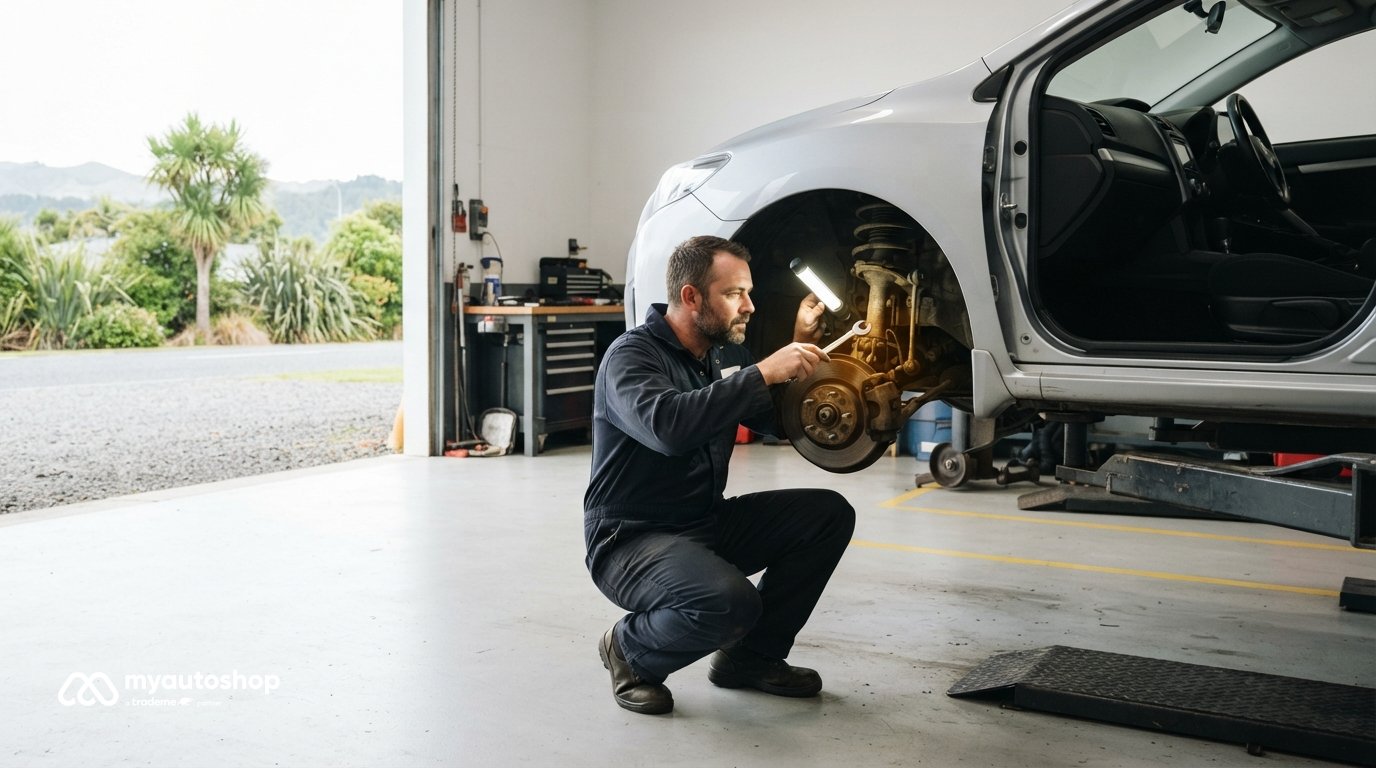
Once the car is in the workshop, visual inspection alone is not enough. Rubber control arm bushes can look intact on the surface while being torn clean through the centre. Mechanics insert a heavy-duty pry bar between the subframe and control arm, applying controlled leverage to expose hidden separation and play.
Next, technicians check ball joints against manufacturer tolerances using dial indicators or joint play gauges. Finally, shock absorbers are inspected. Technicians differentiate between normal light oil misting, which passes a Warrant of Fitness, and active hydraulic fluid running down the strut body, which requires prompt shock absorber replacement alongside deteriorated bump stops. If your vehicle also produces a humming noise from wheels that gets louder with speed, this can indicate a worn wheel bearing that technicians will also evaluate during the axial steering check phase.
For drivers who prefer diagnostics completed at their driveway or workplace, mobile mechanics through Turners Service & Repairs provide on-site inspections in selected operating regions across New Zealand.
Is It Safe to Drive with a Clunking Front Suspension?
Continuing to drive with a distinct clunking noise from front suspension over bumps is never safe. A clunk is not a harmless cosmetic annoyance; it confirms that internal mechanical clearances have exceeded safe working tolerances. While a worn sway bar drop link might only create noisy body roll, a failing lower ball joint or damaged control arm bush jeopardises your physical connection to the road.
Immediate Safety Hazards and Handling Deterioration
Front suspension assemblies keep your tyres planted firmly against the asphalt. When rubber compliance bushes tear or ball joints develop slack, dynamic alignment fails. Under heavy braking, kinetic force wrenches the lower control arm backwards, instantly throwing toe and camber angles out of alignment.
This unwanted movement causes unpredictable steering pull, aggressive tramlining, and rapid tyre tread scrubbing. In wet Kiwi conditions, worn shock absorbers struggle to keep tyres pressed to uneven chip seal, dramatically increasing emergency stopping distances. In severe scenarios, a fatigued ball joint can pull completely out of its housing, dropping the vehicle chassis onto the road with a total loss of steering. If you notice a pulsing brake pedal or vibration through the steering wheel when slowing down alongside suspension issues, it is also worth understanding how to tell if you need new brake rotors, as worn or damaged rotors can compound braking instability on uneven road surfaces.
Warrant of Fitness (WoF) Compliance in New Zealand
Under Waka Kotahi NZTA vehicle inspection rules (VIRM Section 9-1), any steering or suspension component exhibiting excessive play, structural cracking, or perishing fails certification immediately. Vehicle inspectors test every linkage under load. Split rubber boots that allow protective grease to leak from ball joints or tie rod ends trigger an immediate fail, as does active hydraulic fluid running down a shock absorber body. Similarly, a split CV boot that has allowed grease to escape from the constant velocity joint is a common WoF failure point — drivers who want to understand what is a CV boot and why is it important will find it directly relevant to passing their next inspection.
If your car fails due to steering or suspension faults, you are entitled to a free re-inspection within 28 calendar days at the same testing station. However, driving on an expired WoF during this period is legally permitted only for traveling directly to obtain repairs or a retest. Review our comprehensive guide on Warrant of Fitness (WOF) in NZ to learn what inspectors look for during an assessment.
Avoid risking roadside breakdown or an unexpected inspection failure. You can find pre-vetted independent workshops and book an underbody safety check through My Auto Shop to resolve front-end slack before it compromises your safety.
How to Fix Suspension Clunks: Professional Inspection and Repairs
Resolving an underbody knock requires targeted component replacement rather than guesswork. Attempting DIY driveway repairs on front-end assemblies can be hazardous, particularly when dealing with high-tension coil springs or seized fasteners. Professional technicians use dedicated hydraulic presses, pullers, and spring compressors to install replacement parts safely and correctly, permanently stopping that clunking noise from front suspension over bumps.
Component Replacement and Mandatory Wheel Alignment
Technicians routinely recommend replacing key suspension components in axle pairs. If an anti-roll bar drop link, strut top mount, or lower control arm bush has failed on the left side, the right side has endured identical road mileage and will likely fail soon after. Installing fresh parts across both sides preserves dynamic handling balance.
Every major front-end repair also demands a computerised four-wheel alignment. Unbolting control arms, steering knuckles, or tie rods completely resets your suspension geometry. Even a fractional change in subframe alignment alters camber, caster, and toe settings. Without a precise post-repair alignment, your vehicle may track sideways, leading to steering wheel misalignment and rapid tyre scrubbing within a few hundred kilometres.
Booking Suspension Diagnosis with Qualified Mechanics
Kiwi drivers have flexible, reliable avenues to get front-end issues sorted without stress or hidden costs:
- Independent workshop bookings: Motorists can compare local garages and book transparent, upfront mechanical services nationwide through My Auto Shop.
- Convenient mobile diagnostics: When getting to a workshop doesn’t fit your schedule, Turners Service & Repairs offers professional mobile repairs and vehicle diagnostics in selected New Zealand regions, sending a fully equipped technician right to your driveway or workplace.
If you have never used an on-site service before, read through our helpful guide on What Should I Know About Mobile Mechanics to understand how mobile diagnosis works and whether it suits your repair needs.
Addressing suspension play early keeps repair bills contained, protects your tyres, and ensures your vehicle remains safe and compliant for its next Warrant of Fitness.
Take the Guesswork Out of Front Suspension Repairs
Leaving an underbody knock unchecked rarely saves money in the long run. A persistent clunking noise from front suspension over bumps is your vehicle’s direct way of signalling component play before it ruins fresh tyres or triggers a failed Warrant of Fitness. Professional diagnosis quickly isolates whether you are dealing with a quick drop link replacement or a critical ball joint hazard.
You don’t need to put up with unsettling thuds or stressful garage guesswork. Enjoy complete peace of mind with upfront repair estimates and zero hidden fees. It takes just minutes to find a trusted local mechanic to inspect your suspension on My Auto Shop, connecting you with vetted independent workshops across New Zealand. If you need work done at home or work, Turners Service & Repairs provides convenient mobile repairs and diagnostics in selected regions. Book your inspection today and get your vehicle driving smoothly again.
Frequently Asked Questions
Can I continue driving my car if the front suspension clunks over bumps?
No, you shouldn’t continue driving normally except to travel directly to a repairer. A clunking noise from front suspension over bumps indicates metal-to-metal contact where components have separated or rubber bushes have perished. While worn sway bar links mainly cause irritating noise, failed ball joints or loose control arms can cause catastrophic steering loss or wheel collapse at open road speeds. Have it inspected promptly to prevent safety hazards.
Will a clunking front suspension cause my vehicle to fail its WoF in NZ?
Yes, noticeable suspension clunking almost always results in a Warrant of Fitness failure under Waka Kotahi VIRM regulations. Inspectors strictly test steering and suspension linkages for excessive play, cracking, perishing, and split rubber boots. If play or active hydraulic fluid leakage is detected, your vehicle fails. You then have 28 days to complete the necessary repairs and return for a free re-inspection at the same testing station.
What is the most common cause of front-end suspension clunking?
Worn sway bar drop links are the single most frequent cause of front suspension knocks. These compact links absorb constant twisting forces whenever your vehicle traverses uneven road surfaces or speed humps. Because their small ball-and-socket joints endure continuous movement, they develop mechanical play faster than larger structural components. Deteriorated sway bar D-bushings and torn lower control arm compliance bushes are the next most common failure points.
Why does the front suspension clunk only when turning over bumps?
Clunking that occurs specifically while turning over bumps points to steering-connected suspension components or rotational bearings. MacPherson strut top bearings pivot during steering inputs; if the bearing plate has collapsed or seized, turning while compressing the spring creates loud popping or clunking sounds. Worn outer tie rod ends, loose lower ball joints, or a deteriorating steering rack can also shift abruptly under combined steering angle loads and vertical road bumps.
Do I always need a wheel alignment after fixing suspension components?
Yes, you should always get a computerised wheel alignment after replacing front suspension or steering parts. Disconnecting tie rods, lower control arms, or MacPherson strut assemblies shifts your vehicle’s factory camber, caster, and toe geometry. Even minute alignment variances can cause the car to pull to one side, reduce stability during wet braking, and wear out brand-new tyres within just a few hundred kilometres.
How do mechanics determine whether a shock absorber or a bushing is worn?
Mechanics use distinct physical tests to evaluate shocks and bushes. For bushes, technicians use heavy pry bars to apply leveraged lateral force, looking for torn, debonded, or perished rubber. For shock absorbers, they inspect the damper body for active fluid leaks, check the integrity of bump stops, and evaluate rebound dampening during a road test. Light oil misting passes inspection, but streaming hydraulic fluid requires full replacement.
Can a mobile mechanic repair a clunking front suspension at my home?
Yes, qualified mobile mechanics can diagnose faults and replace many front-end parts on-site. Technicians from Turners Service & Repairs can inspect steering linkages, replace sway bar links, and fit new shock absorbers right at your home or workplace in selected New Zealand regions. However, for complex jobs requiring heavy subframe drops or immediate computerised four-wheel alignment equipment, booking an independent workshop through My Auto Shop is recommended.
Disclaimer
This article provides general information only and should not be relied on as professional mechanical, safety or legal advice. Vehicle requirements and circumstances vary. If you are unsure about your vehicle, have it inspected by a qualified automotive professional.