
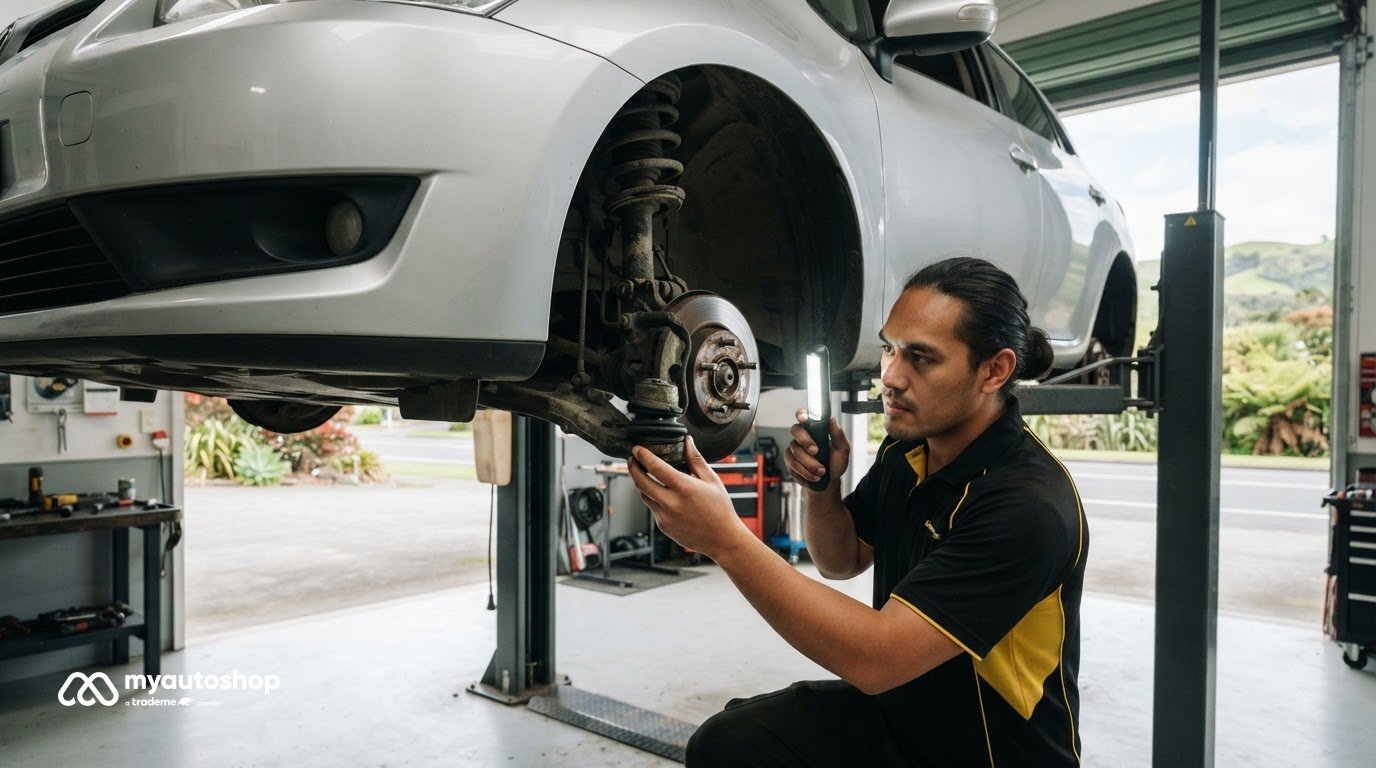
Could a clunk over bumps be more than an annoying suspension noise? The signs of worn ball joints can start with a knock, squeak or change in steering, and they’re easy to mistake for a minor issue. Take these symptoms seriously if you’re unsure whether your car is safe. A badly worn joint can affect steering control and, in an extreme case, fail and allow a wheel to separate from the suspension.
These symptoms can have other causes, so noise alone won’t confirm a faulty ball joint. This guide explains what to look and listen for, the safety risks, and what to do next. It also covers how worn joints may affect a Warrant of Fitness: steering and suspension components must be safe and in good condition, and excessive play can lead to a WoF failure. Knowing the warning signs can help you arrange an assessment before the problem gets worse.
Key Takeaways
- Clunks over bumps, squeaks while turning, steering vibrations, wandering and uneven tyre wear can be signs of worn ball joints, but a mechanic should confirm the cause.
- Check the rubber grease boots for splits or leaks, but leave the wheel-play test to someone with the right equipment if you’re unsure how to raise and secure your car safely.
- Excessive ball-joint play can affect vehicle safety and may lead to a WoF failure. Don’t wait for your next inspection if you suspect a problem.
- A mechanic can advise whether the joint or the complete control arm needs replacing, and whether a wheel alignment is needed after suspension work.
- Buying a used car with suspension noise? A My Auto Shop pre-purchase inspection can help you understand its condition before you buy.
What Are Ball Joints and Why Do They Wear Out?
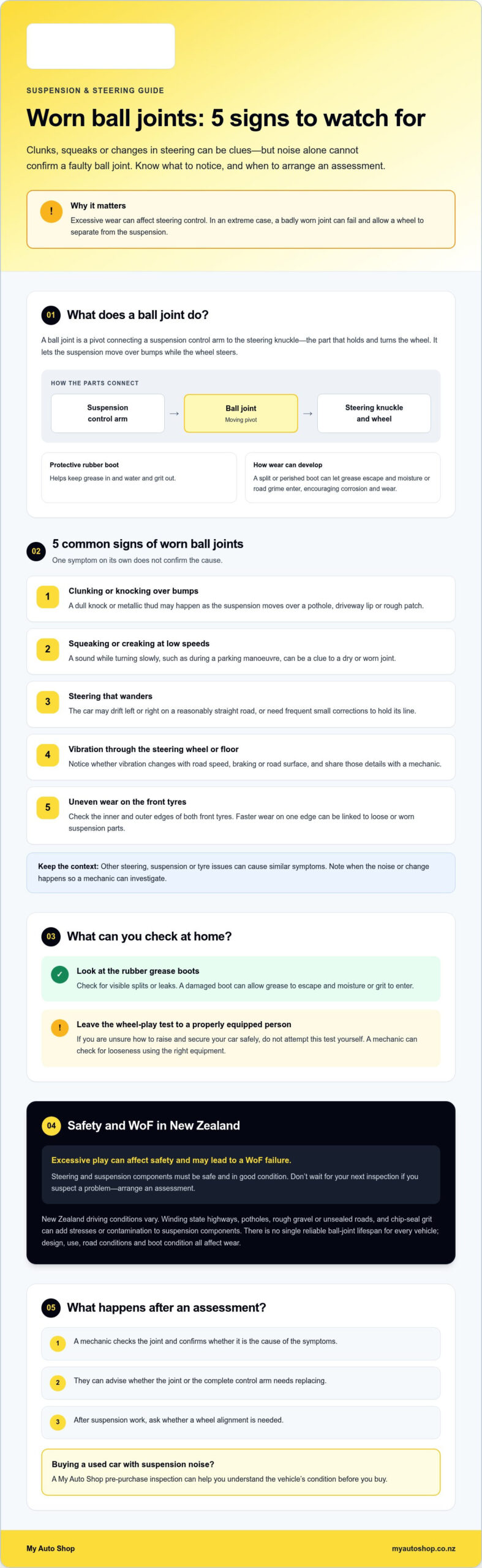
Ball joints are pivot points that connect the suspension control arms to the steering knuckles, the parts that hold and turn the wheels. Each joint has a rounded stud that moves inside a socket, much like a ball-and-socket joint in your body. This lets the suspension move over bumps while the wheels steer. A protective rubber boot helps keep grease inside and water and grit out. For a technical overview, see What Are Ball Joints.
Wear develops as the joint’s moving surfaces and protective boot deteriorate. If the boot splits or perishes, grease can escape and moisture and road grime can get inside, encouraging corrosion and wear. The damage may eventually create looseness in the joint, one of the signs of worn ball joints.
This video shows common symptoms to look out for:
The role of ball joints in steering
Ball joints let a wheel move up and down with the suspension while also turning left or right with the steering. In some suspension designs, a load-bearing joint supports part of the vehicle’s weight; a follower joint guides movement but doesn’t carry the main load. Their roles depend on the vehicle’s suspension layout. Because they help locate the steering knuckle, excessive wear can affect how consistently the wheel holds its intended position and alignment.
New Zealand conditions and suspension stress
Regular cornering on winding state highways puts changing forces through the suspension. Potholes and rough gravel or unsealed roads can add sharp impacts. Chip-seal surfaces can also throw loose stones and road grit towards the underside of a vehicle. These conditions don’t determine a joint’s lifespan on their own, but they can add to the stresses and contamination suspension components face.
There’s no reliable lifespan that applies to every ball joint in New Zealand’s varied vehicle fleet. Design, vehicle use, road conditions and the state of the protective boot all affect wear. Check for damage during routine inspections, especially if you regularly drive rough roads. If you’re considering a used car with suspension noise, a vehicle symptoms guide can help you decide what to investigate further.
5 Common Signs of Worn Ball Joints
The signs of worn ball joints often show up as changes in noise, steering or tyre wear. One symptom on its own doesn’t confirm the cause: other suspension or steering parts can produce similar problems. Note when each symptom happens to help a mechanic diagnose it.
1. Clunking or knocking over bumps
A worn joint may have excess movement between its ball and socket. As the suspension shifts over a pothole, driveway lip or rough patch, that play can create a dull knock or metallic thud from the front of the car. For other possible causes, see this guide to clunking noise from the front suspension over bumps.
2. Squeaking or creaking at low speeds
A squeak or creak while turning slowly, such as during a parking manoeuvre, can point to a dry or worn joint. The sound may be more noticeable as the suspension moves and the steering changes direction. Worn bushes and other components can make similar noises, so treat this as a clue, not a diagnosis.
3. Steering that wanders
If the car seems to drift left or right on a reasonably straight road, or needs frequent small corrections to hold its line, the steering may feel loose or imprecise. A worn ball joint can affect how securely the wheel is located. Tyre pressure, alignment and other steering or suspension faults can also cause wandering. The symptoms of worn control arm bushings can produce similar steering vagueness, so a mechanic should assess which component is at fault.
4. Vibration through the steering wheel or floor
Excessive joint movement can contribute to vibration, which you may feel through the steering wheel or floor. Notice whether it changes with road speed, braking or road surface, and share those details with a mechanic. Vibration has many possible causes, including tyres and wheel balance.
5. Uneven wear on the front tyres
Check the inner and outer edges of both front tyres. If one edge is wearing faster than the rest, worn or loose suspension parts may have affected the wheel’s position. Continued misalignment can shorten tyre life, so arrange an inspection rather than waiting for the tread to wear further.
These symptoms matter for safety as well as comfort. Waka Kotahi’s WoF inspection requirements for ball joints explain how steering and suspension condition is assessed. If the car feels unsafe or the symptoms are worsening, avoid unnecessary driving and seek professional advice. Turners Service & Repairs provides mobile mechanical services in selected regions. Check whether Turners Service & Repairs mobile mechanic services are available in your area.
How to Check for Ball Joint Wear at Home
A careful visual check can reveal damage, but it can’t confirm whether a ball joint has excessive play. Look for warning signs only if you can do so safely. Don’t get underneath a car supported only by a trolley jack.
Start with a visual inspection
With the car parked on level ground and the wheels straight, look behind the front wheels for the ball joints and their rubber grease boots. The boot covers the joint where the control arm meets the steering knuckle. Check for splits, a boot that has come loose, or grease escaping around it. Don’t touch hot or moving parts.
A damaged boot matters because it can let grease out and water or dirt in, speeding up wear and corrosion. But a split boot alone doesn’t automatically confirm that the joint has failed or that the car will fail its WoF. An inspector assesses the component’s condition and safety, including any excessive play. For more guidance on interpreting vehicle symptoms, see the Turners symptoms guide.
Checking for wheel play
A wheel-rocking check involves lifting the wheel, then holding the tyre at the 12 and 6 o’clock positions and gently rocking it. Movement may indicate looseness, but it doesn’t identify the cause on its own. A worn ball joint and a wheel bearing can both produce play, and the right checks depend on the vehicle’s suspension design.
Only attempt this if you know how to support the vehicle safely. Use a firm, level surface, follow the vehicle maker’s jacking points, chock the wheels that remain on the ground, and support the raised vehicle with correctly positioned jack stands. Never put any part of your body under a car held up by a trolley jack alone. If you don’t have suitable stands or aren’t confident, skip the test.
Leave the pry-bar test to a professional
A mechanic may use a pry bar to check for movement at the joint while the suspension is positioned appropriately. The method varies by vehicle, and levering against the wrong part can damage components or create a safety risk. It’s not a good shortcut for a home diagnosis.
If you find visible damage, feel movement, or hear clunks while driving, arrange a professional inspection rather than trying to decide which part has worn. A mechanic can distinguish ball-joint play from wheel-bearing or other suspension movement and advise whether the car is safe to drive. If it feels unstable, avoid driving it until it has been checked.
Safety Risks and WoF Implications in NZ
A ball joint that wears badly can eventually separate: its stud may pull out of the socket, allowing the wheel and steering knuckle to move out of position or collapse. If this happens while driving, you could lose control of the affected wheel. A weakened joint may also fail during a slow turn or parking manoeuvre, so don’t assume a fault is harmless because it hasn’t happened at speed.
Failure can damage nearby parts, such as the CV axle, brake lines or bodywork. It can also leave the vehicle unable to be driven, requiring recovery as well as repairs. Don’t wait for a dramatic noise or visible wheel movement. Acting on the signs of worn ball joints gives a mechanic the chance to assess the fault before it develops into a breakdown or further damage.
Why a worn joint is a safety risk
The joint helps hold the wheel in its correct position while allowing it to steer and move with the suspension. If it has excessive play, handling can become unpredictable. A complete separation is a serious risk, but there’s no reliable warning timetable: symptoms may worsen gradually, or a severely damaged component may fail suddenly. If the steering feels unstable or you suspect a joint is close to failure, stop driving when safe and arrange professional advice.
Having a developing fault checked is generally more controlled than dealing with a vehicle that has broken down or suffered secondary damage. Don’t treat a WoF as a substitute for responding to new noises or changes in handling. It checks the vehicle at a particular time, not its condition on every later trip.
What a ball joint fault means for your WoF
For a WoF, steering and suspension components must be safe and in good condition. An inspector assesses the joint for issues such as play beyond the vehicle manufacturer’s specifications, rough operation, damage or insecure fittings. A worn joint that falls outside safe limits can result in a WoF failure. A damaged or perished rubber boot should be checked, but it does not automatically mean a fail if the joint itself remains within the applicable safety requirements. See Waka Kotahi’s steering and suspension inspection requirements for the inspection criteria.
Have concerning symptoms assessed before your WoF appointment rather than relying on the inspection to uncover them. Turners Service & Repairs offers mobile mechanical repairs in selected regions. Check availability for your area if you need a diagnosis or repair.
Fixing Worn Ball Joints: Next Steps for NZ Drivers
If a mechanic confirms a worn ball joint, the right repair depends on your vehicle’s suspension design and the condition of the surrounding parts. Some joints can be replaced on their own. On other vehicles, the joint is integrated into the control arm, or corrosion and damage make replacing the complete arm the sensible option. Ask what has failed and why the recommended repair is needed.
What replacement involves
A ball joint can be a tight fit. Removing and installing one may require a specialist ball-joint press and vehicle-specific procedures, so it’s not a straightforward job for every home mechanic. A professional can check the joint, control arm and related components before explaining the repair options.
Replacing joints in pairs isn’t automatically necessary. The mechanic should inspect both sides and recommend replacing the other joint if its condition or the vehicle manufacturer’s guidance supports it. After suspension work, ask whether a wheel alignment is needed. Replacing a component can affect wheel position, and incorrect alignment may contribute to uneven tyre wear or imprecise handling.
Choose the right next step
Hearing a clunk or knock? Arrange an inspection rather than waiting for the noise to worsen. Turners Service & Repairs provides mobile mechanical repairs and diagnostics in selected New Zealand regions, which can be a convenient option for getting a vehicle checked at home. Coverage is limited to selected regions, so confirm availability for your area.
For clarity about how charges are explained, read the Turners Service & Repairs fair pricing information. If the assessment confirms a repair is needed, ask for a clear explanation of the recommended work before proceeding.
Buying a used car that has suspension noise? A WoF is a safety check at a point in time, not a full assessment of the vehicle’s mechanical condition. A My Auto Shop pre-purchase inspection can help you understand the car’s condition before you buy, including concerns that warrant further investigation.
If your current car is making a clunk, describe when the noise or steering change happens when arranging an assessment. Avoid driving the car if it feels unsafe.
Act early to protect your safety
Clunks over bumps, squeaks while turning, wandering steering and uneven front tyre wear can all be signs of worn ball joints. None confirms the cause on its own, but changes in steering or suspension are worth checking promptly. A visual check may reveal a damaged rubber boot, while confirming play and deciding on the right repair requires a proper assessment.
Don’t rely on your next Warrant of Fitness to catch a developing fault. If your car feels unstable, avoid driving it until you’ve sought advice. If you’re considering a used car with suspension noise, a My Auto Shop pre-purchase inspection can help you understand its condition before you buy.
A professional assessment is a practical next step towards safer, more confident driving. Check Turners Service & Repairs mobile mechanic availability in your area if you need help with a diagnosis or repair.
Frequently Asked Questions
Is it safe to drive with worn ball joints?
It may not be safe, especially if the joint has significant play or the steering feels loose. A severely worn joint can separate and let the wheel move out of position, potentially causing loss of control. If you notice the signs of worn ball joints, such as clunking or wandering steering, arrange a professional assessment. If the car feels unstable, stop somewhere safe and seek advice before driving further.
How much does it cost to replace ball joints in NZ?
There’s no fixed price for ball-joint replacement in New Zealand. The cost depends on the vehicle’s suspension design, whether the joint can be replaced separately or is part of the control arm, and the work required. Ask the mechanic to explain the diagnosis and provide a clear quote before authorising repairs. Check whether related work, such as a wheel alignment, is recommended and included in the estimate.
Will worn ball joints fail a WoF?
They can. During a WoF inspection, steering and suspension components must be safe and in good condition. A ball joint with play beyond the vehicle manufacturer’s specifications or outside safe tolerance may cause a failure. Inspectors also consider damage, security and smooth operation. A split boot should be checked, but it doesn’t automatically mean a WoF failure if the joint itself meets the applicable safety requirements.
How long do ball joints usually last?
There isn’t one lifespan that applies to every ball joint. Durability varies with the vehicle’s design, condition, driving habits and exposure to rough roads, moisture and road grime. A damaged rubber boot can allow grease to escape and contaminants to enter, accelerating wear. Pay attention to new suspension noises, steering changes or uneven tyre wear, and have them assessed rather than relying on a mileage estimate.
Should I replace both ball joints at the same time?
Not automatically. A mechanic should inspect both sides and recommend replacement based on their condition, the vehicle’s design and the manufacturer’s guidance. If one joint is worn, the other may still be serviceable, but it’s sensible to have it checked while the suspension is being assessed. Ask why replacing one or both is recommended, and whether a wheel alignment is needed after the repair.
What is the difference between a ball joint and a tie rod end?
A ball joint connects suspension parts, typically the control arm and steering knuckle, and allows the wheel to move with the suspension while steering. A tie rod end connects the steering rack or linkage to the wheel’s steering arm, transferring steering movement to turn the wheel. Both use a ball-and-socket type joint, and wear in either can affect handling. If you’re unsure which component is causing your symptoms, the signs of a bad tie rod end can help you compare what to look and listen for. A mechanic can identify which component is causing play or noise.
Can I replace ball joints myself at home?
It depends on your experience, tools and vehicle. Some ball joints require specialist tools, such as a press, and safe access to the suspension. Incorrect lifting or fitting can create serious risks, so never work under a car supported only by a trolley jack. If you’re not confident or don’t have the right equipment, have a mechanic diagnose and repair the joint, then confirm whether alignment is needed.
Disclaimer
This article provides general information only and should not be relied on as professional mechanical, safety or legal advice. Vehicle requirements and circumstances vary. If you are unsure about your vehicle, have it inspected by a qualified automotive professional.